Подписывайтесь на нас


Подписывайтесь на нас
категории
недавний посты
Water-based aluminum paste is widely used in metallic coatings for its silver appearance, brightness, and reflective effect. In functional coating systems, however, its role extends beyond appearance. Thin, plate-like aluminum flakes can reduce light transmission, create overlapping reflective layers, and influence the barrier properties of the cured film.
These characteristics make water-based aluminum paste relevant to light-blocking, UV-shielding, reflective, roof, tank, and protective coatings. However, light blocking, solar reflectance, thermal emittance, and barrier performance are related but different. A coating may hide a substrate well without exceptionally high total solar reflectance, while a bright metallic surface may still have relatively low long-wave thermal emittance.
Water-based aluminum paste is a flake-shaped metallic pigment engineered for aqueous or water-reducible coating systems. It is not simply untreated aluminum powder dispersed in water.
Aluminum can react under unsuitable aqueous conditions, so waterborne aluminum pigments normally require chemical inhibition, encapsulation, or another surface modification. A major review of aluminum-pigment inhibition explains that the move from solvent-borne to waterborne coatings creates a specific stability challenge because aluminum can react with water. Organic inhibitors, surfactants, polymer treatments, and inorganic surface treatments are therefore used to protect the pigment surface.[3]
For coating manufacturers, water-based aluminum paste combines flake engineering and surface chemistry. Particle size, thickness, aspect ratio, and morphology influence brightness, hiding, and reflection, while surface treatment must keep the pigment sufficiently stable in the intended waterborne formulation. Selection should therefore consider resin chemistry, pH, additives, processing, storage, and end use as well as optical appearance.
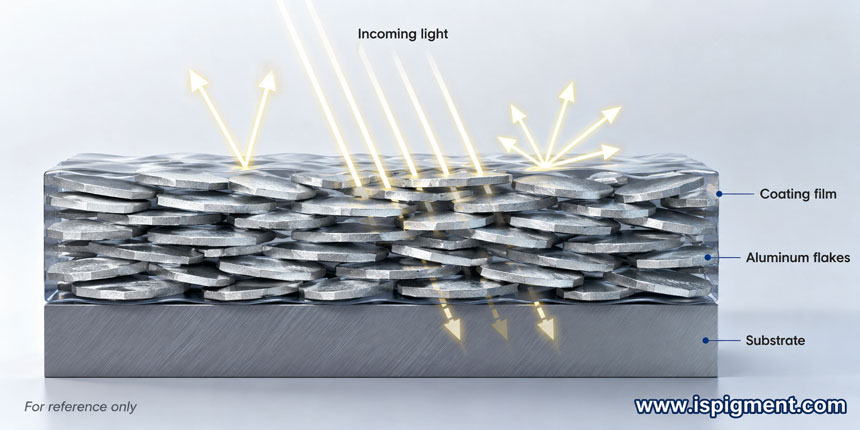
Aluminum flakes are opaque metallic particles. When dispersed in a coating film, they reduce the amount of light that can pass through the binder and reach the substrate.
Their plate-like geometry is especially important. Thin flakes can cover a relatively large projected area compared with more equiaxed particles of similar mass. When many flakes overlap, incoming light encounters multiple metallic interfaces before it can travel through the film. This contributes to hiding through reflection, scattering, and reduced transmission.
During application and drying, many aluminum flakes tend to orient approximately parallel to the coating surface. This orientation strongly affects optical behavior.
Research on metallic coatings has directly shown that processing conditions can change aluminum-flake orientation and that different orientation distributions produce measurable differences in optical reflectance.[1]
A flake lying close to parallel with the substrate presents a large projected metallic area to incoming light. When many flakes have similar orientation, the coating can develop stronger directional reflection and more efficient optical coverage. If the flakes are highly tilted, agglomerated, folded, or mechanically damaged, the optical structure becomes less uniform.
Hiding performance therefore cannot be predicted from aluminum-paste dosage alone. Viscosity, rheology, drying rate, film thickness, particle size, resin flow, and application conditions all influence orientation, so two coatings with the same dosage can still show different brightness, reflectivity, and hiding power.
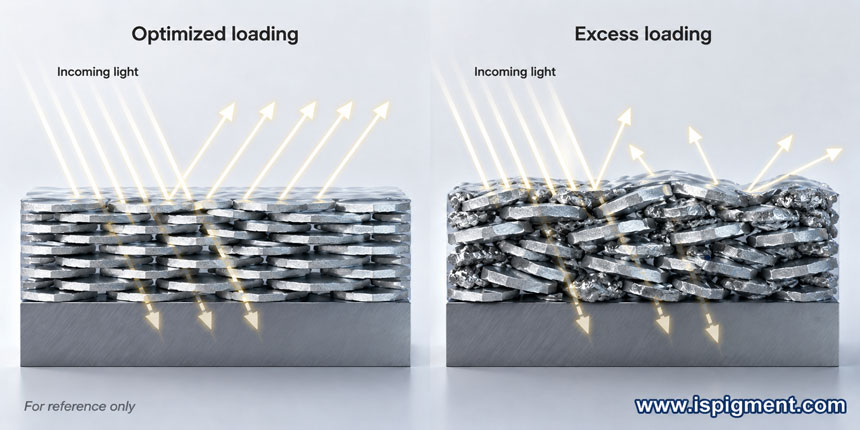
It may seem logical that increasing aluminum pigment concentration should continuously improve light blocking. In practice, the relationship is not always linear.
Research into aluminum-flake orientation identified a critical pigment concentration above which the degree of surface-parallel orientation could decrease. The same work also observed changes in coating properties when aluminum concentration exceeded the favorable formulation range.[2]
At low pigment levels, insufficient flake coverage may leave too much optical transmission. Increasing concentration can improve coverage until an efficient overlapping structure develops. Beyond the useful range, excessive loading may interfere with flake alignment, increase surface roughness, reduce binder continuity, change adhesion, or create pigment crowding.
The objective is therefore to reach a formulation window that provides sufficient flake coverage while maintaining orientation and film integrity.
Exterior coatings are exposed to ultraviolet, visible, and near-infrared radiation. These wavelength regions affect the coating differently.
Visible light is closely related to hiding power and visual opacity. UV radiation contributes to polymer degradation and weathering. Near-infrared radiation is invisible but represents an important part of the solar energy reaching an exterior surface.
Aluminum flakes can reflect radiation over a broad spectral range, but the finished coating does not behave exactly like polished bulk aluminum. Binder absorption, other pigments, particle orientation, surface roughness, film thickness, contamination, oxidation, and substrate color all influence the final optical response.
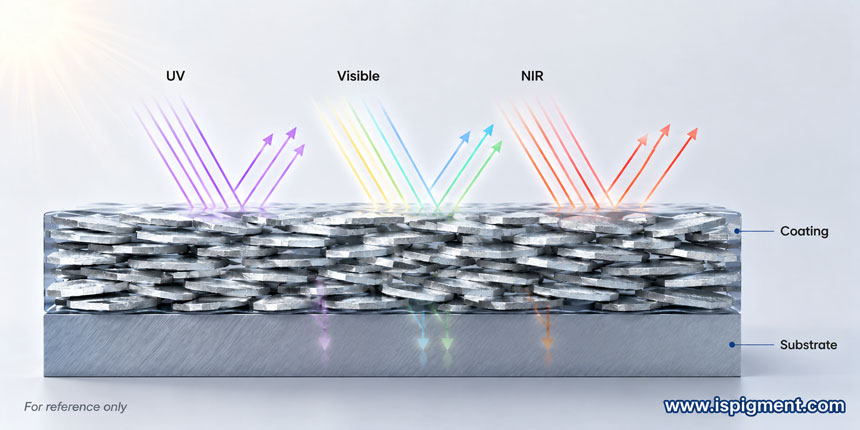
For this reason, describing a water-based aluminum paste as providing “100% light blocking” is too absolute unless the finished coating has been tested under a defined method and dry-film thickness. A more technically defensible statement is that overlapping aluminum flakes can reduce light transmission and improve hiding power.
Metallic flakes can also reduce UV penetration, but aluminum paste is not a substitute for weather-resistant resin chemistry, UV absorbers, light stabilizers, or sufficient film thickness. Durable UV protection comes from the complete formulation.
When sunlight reaches an exterior coating, part of the energy is reflected and part is absorbed. The absorbed portion contributes to heating of the coating and substrate. Increasing solar reflectance reduces the solar energy available for absorption.
Aluminum is reflective, and appropriately oriented flakes can create strongly reflective interfaces within or near the coating surface. However, visual metallic brightness and total solar reflectance are not interchangeable.
A coating that looks bright is being judged mainly in the visible region, while solar heat management also depends on wavelengths outside visible light. Claims such as “reflects 85–95% of solar energy” should therefore not be applied universally to water-based aluminum paste. A realistic value can only be established from the finished coating.
Important variables include aluminum grade, particle size, orientation, concentration, resin chemistry, other colorants, dry-film thickness, roughness, aging, and contamination. Water-based aluminum paste is therefore best described as a component that can support solar-reflective coating design, not as a guarantee of a fixed reflection percentage.
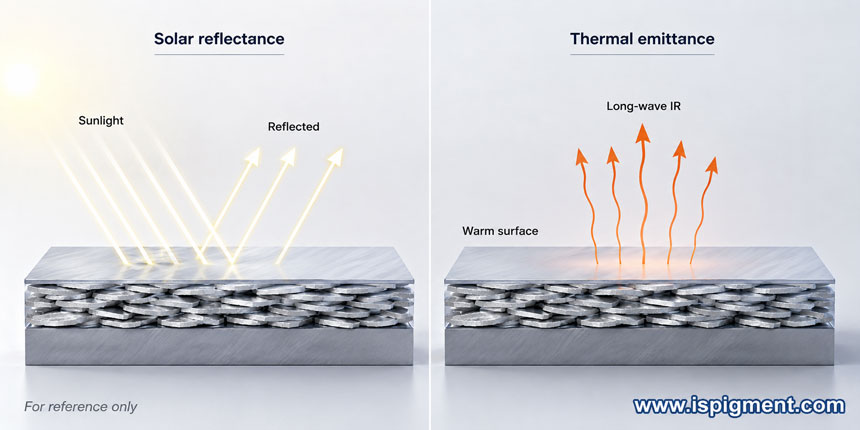
Solar reflectance and thermal emittance describe different physical processes.
Solar reflectance is the fraction of incoming solar radiation reflected rather than absorbed. Thermal emittance describes how effectively a warm surface emits long-wave infrared radiation to its surroundings.
Cool-roof research emphasizes that high solar reflectance and high thermal emittance can help a surface remain cooler under sunlight. The same literature also notes that a surface with lower thermal emittance can still perform well when solar reflectance is sufficiently high.[5]
This distinction is important for metallic coatings. Aluminum-rich surfaces can combine high reflectance with relatively low long-wave emissivity. Low emissivity may be useful where the objective is to limit radiative heat exchange between surfaces, but it is not automatically an advantage for every exterior cool-surface application.
Therefore:
These effects should not be compressed into a single claim such as “aluminum reflects heat.” For roofs or exterior surfaces intended to remain cooler under sunlight, solar reflectance and thermal emittance should be evaluated separately.
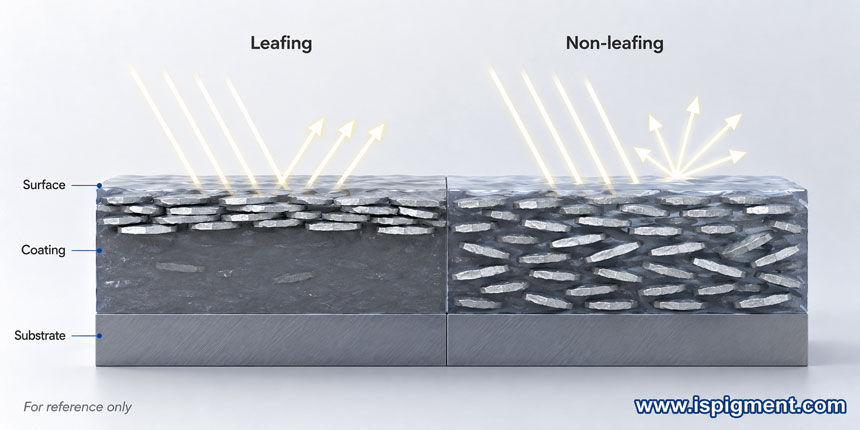
Leafing and non-leafing aluminum pastes differ mainly in how the flakes position themselves during film formation.
Leafing pigments tend to migrate toward or concentrate near the coating surface. Non-leafing pigments remain more evenly distributed through the film. This difference affects metallic appearance, reflectivity, intercoat behavior, and formulation flexibility.
|
Property |
Leafing Aluminum Paste |
Non-Leafing Aluminum Paste |
|
Typical flake location |
Tends toward the coating surface |
Distributed more through the film |
|
Metallic appearance |
Often brighter and more directional |
More integrated metallic effect |
|
Surface reflection |
Can form an aluminum-rich reflective surface |
Reflection occurs through a broader film depth |
|
Light blocking |
Strong surface coverage can support hiding |
Overlapping internal flakes can also provide high opacity |
|
Solar-reflective potential |
Useful where strong surface reflection is required |
Depends more strongly on total formulation and orientation |
|
Thermal emittance |
Aluminum-rich surface may have relatively low emissivity |
More influenced by the binder-rich outer surface |
|
Recoatability |
Can be more difficult in some systems |
Generally better suited to topcoating |
|
Typical focus |
Reflective metallic surfaces |
Industrial, architectural, and multilayer coatings |
Neither type is universally better for heat management. Roof coatings may emphasize surface reflection, while industrial systems may prioritize adhesion, recoating, corrosion resistance, and stable appearance.
The major technical challenge in using aluminum pigment in a waterborne system is chemical stability.
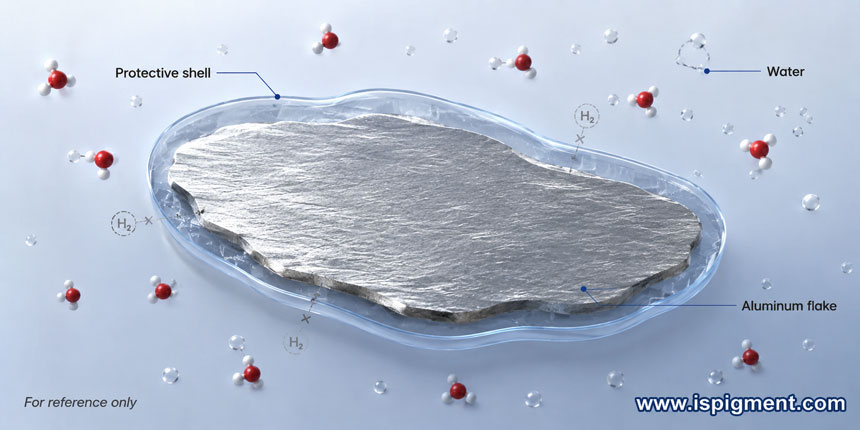
Under unsuitable aqueous conditions, aluminum can react and generate hydrogen, causing package pressure, viscosity changes, pigment darkening, loss of brightness, or poor storage stability.
Scientific literature on aluminum pigment inhibition describes several approaches, including organic inhibitors, surfactants, polymer treatments, and inorganic surface modification.[3]
Silica encapsulation is one recognized route. A protective inorganic layer can reduce direct exposure of the aluminum surface to the aqueous phase. Organic phosphate-type inhibitors, polymeric treatments, and hybrid systems may also be used.
Passivation depends on the complete formulation, not just the treatment name. pH, temperature, storage duration, pigment surface area, resin chemistry, and additives all influence stability.
Accordingly, a statement such as “gassing below 0.5 mL/g” should not be treated as a universal requirement unless the test temperature, duration, formulation, and measurement procedure are defined.
For industrial qualification, more useful checks include gas-evolution testing, storage stability, viscosity change, brightness retention, and compatibility with the target resin system.
The same plate-like geometry that helps block light can also affect transport through a protective coating.
When flakes overlap and orient approximately parallel to the substrate, molecules moving through the film may be forced to follow a longer, more tortuous path.
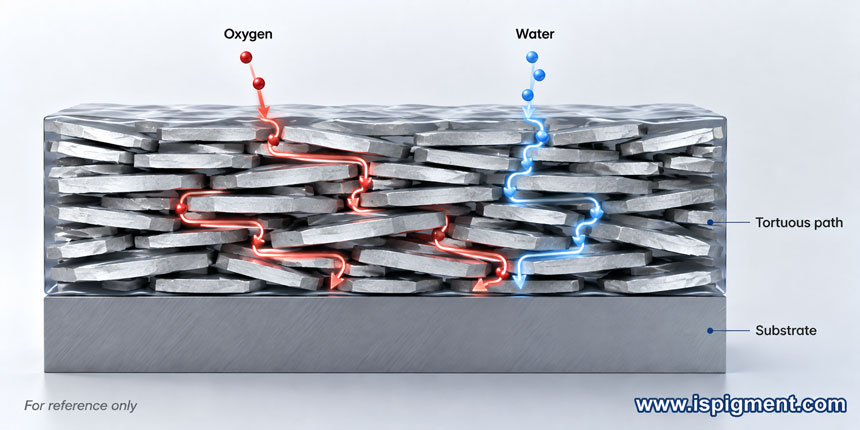
Research on aluminum-pigmented epoxy coatings supports this mechanism but also provides an important limitation. Knudsen and Steinsmo found that aluminum flake pigment could substantially reduce oxygen diffusion, while the reduction in water diffusion was much smaller.[4]
This means aluminum flakes should not be described as forming a completely impermeable metal barrier inside a polymer coating.
For reflective coatings, barrier performance is better treated as an additional functional benefit rather than the main explanation for solar heat management. Light blocking is primarily an optical transmission issue; solar reflectance concerns radiant energy; barrier performance concerns mass transport. All three can benefit from flake orientation, but they should be evaluated separately.
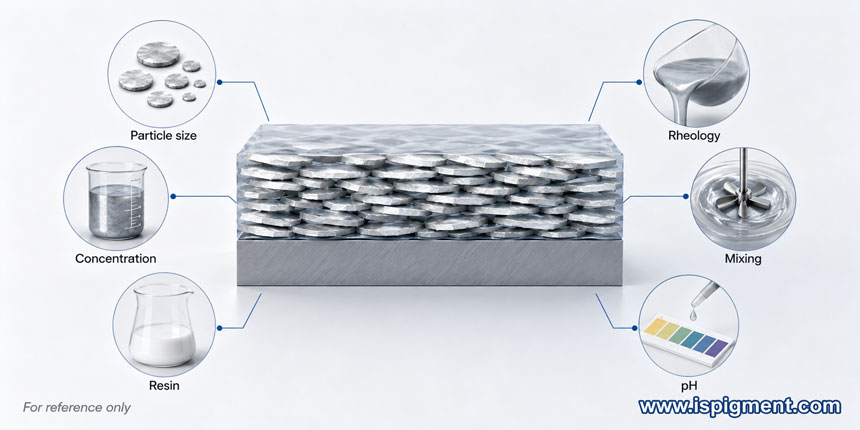
Final coating performance depends on how the pigment interacts with the whole formulation.
Particle size. Coarser flakes can create stronger directional reflection and sparkle, while finer grades can provide smoother optical coverage. Particle size also affects orientation and surface area.
Flake geometry. Thin, high-aspect-ratio flakes can cover a large projected area. Mechanical damage that bends or breaks them can reduce this benefit.
Pigment concentration. Too little aluminum may leave incomplete optical coverage, while excessive loading can interfere with orientation and film properties.[2]
Resin characteristics. Binder transparency and absorption influence how much radiation reaches the flakes and how much reflected light escapes the coating.
Rheology and application. Viscosity, spray atomization, leveling, evaporation rate, and film thickness affect how flakes move before the film locks in place.[1]
Mixing conditions. Excessive shear can damage delicate flakes or change their size distribution.
Waterborne compatibility. pH and additive selection are critical because a pigment stable in one waterborne system may not behave the same way in another.[3]
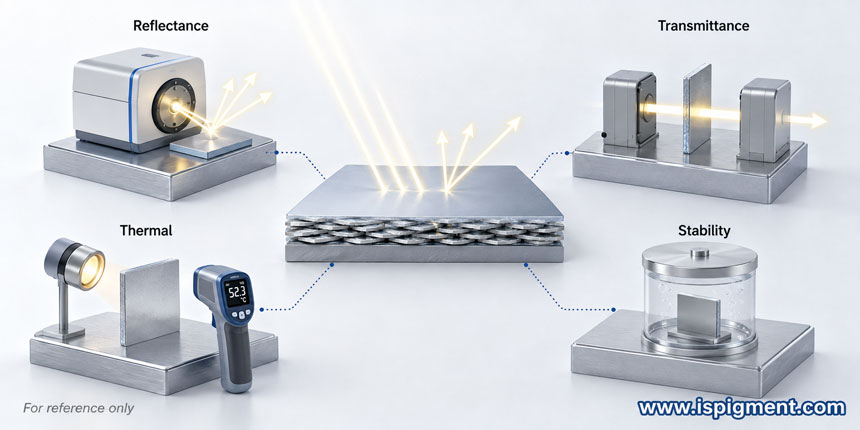
Visual judgment is useful for metallic appearance, but it is not enough for validating light blocking or thermal performance.
|
Intended Claim |
More Appropriate Evaluation |
|
High hiding power |
Contrast ratio or visible-light transmittance at defined dry-film thickness |
|
Light blocking |
Visible or spectral transmittance |
|
UV shielding |
UV transmittance/reflectance plus weathering evaluation |
|
Solar reflective |
UV-Vis-NIR reflectance and calculated total solar reflectance |
|
Cooler exterior surface |
Solar reflectance, thermal emittance, and temperature testing |
|
Low-emissivity coating |
Long-wave thermal-emittance measurement |
|
Waterborne stability |
Defined gas-evolution test, storage stability, viscosity, and appearance |
|
Barrier protection |
Oxygen/water transport and corrosion testing |
|
Low VOC |
VOC measurement of the complete formulation |
This prevents a common marketing error: using one measured property to imply several unmeasured benefits. Metallic brightness is not solar reflectance; solar reflectance is not thermal emittance; hiding power is not proof of UV-weathering durability.
In reflective roof coatings, water-based aluminum paste can support metallic reflection in lower-solvent systems. The finished coating should still be evaluated for solar reflectance, thermal emittance, weathering, dirt pickup, and reflectance retention.[5]
For industrial storage tanks and exterior metal structures, aluminum-pigmented coatings can combine hiding with reflective behavior. Reduced solar absorption may help limit surface heating, but the magnitude depends on the complete coating, substrate, environment, and exposure.
In protective metal coatings, aluminum flakes can combine opacity with lamellar barrier effects. The barrier mechanism is particularly relevant where oxygen transport and corrosion protection matter.[4]
In automotive and industrial metallic coatings, appearance may remain the primary reason for choosing aluminum paste. Waterborne stability, orientation, flop, gloss, DOI, spray behavior, and intercoat adhesion can be more important than thermal performance.
Formulators should begin with the finished coating requirement rather than simply asking for the brightest grade.
Key questions include the target substrate, resin system, formulation pH, leafing or non-leafing requirement, particle-size range, dry-film thickness, topcoat requirement, storage-stability target, and whether the main objective is hiding power, metallic brightness, solar reflectance, barrier performance, or a combination.
Particle-size distribution, surface treatment, non-volatile content, recommended incorporation method, gassing stability, and resin compatibility should then be compared.
For solar heat management projects, candidate pastes should be tested in the actual formulation rather than assuming the brightest pigment will produce the highest total solar reflectance.
For manufacturers developing water-based reflective and protective coatings, iSuoChem can support aluminum paste selection according to particle size, metallic effect, waterborne compatibility, application system, and formulation requirements. Final performance should then be confirmed with optical, thermal, stability, and durability tests appropriate to the end use.
Water-based aluminum paste can contribute to light blocking and solar heat management because its thin metallic flakes create opaque and reflective interfaces inside the coating.
When the flakes are appropriately oriented, optical reflectance can change significantly.[1] Increasing aluminum content indefinitely does not necessarily improve performance because excessive pigment loading can reduce favorable orientation and alter film properties.[2]
Waterborne use also requires suitable surface treatment to reduce undesirable reactions between aluminum and the aqueous phase.[3] The same plate-like structure can influence protective performance by creating a more tortuous diffusion path, although oxygen and water transport are affected differently.[4]
Finally, solar heat management should not be reduced to the statement that “aluminum reflects heat.” Solar reflectance and thermal emittance describe different physical processes and should be evaluated separately.[5]
For coating formulators, the most suitable water-based aluminum paste is not simply the grade with the highest brightness or aluminum content. It is the grade whose particle size, flake orientation, concentration, surface treatment, waterborne stability, and resin compatibility work together to produce the required performance in the final coating.
теги :
Авторские права © 2026 iSuoChem.все права защищены.
профессиональная команда для обслуживания !
 web@ispigment.com
 +86 13965049124
 русский
  English
 français
 italiano
 español
 português
 العربية
 한국의
한국의 ไทย
ไทย Tiếng Việt


