Подписывайтесь на нас


Подписывайтесь на нас
категории
недавний посты
Some fluorescent pigments for water-based systems can contain formaldehyde because certain traditional daylight fluorescent pigments use formaldehyde-related amino resins, such as melamine-formaldehyde or benzoguanamine-formaldehyde systems, as the polymer matrix for fluorescent dyes.[1,2] The water-based medium itself does not create the formaldehyde. Instead, measurable free formaldehyde may be associated with the pigment’s resin chemistry and manufacturing process. It is therefore important to distinguish between formaldehyde used to build the resin, residual or free formaldehyde in the finished pigment, and formaldehyde that may be released under particular conditions. Formaldehyde-free fluorescent pigments use alternative resin technologies, but their fluorescence, dispersion stability, migration resistance and compatibility still need to be evaluated for the intended water-based formulation.
For formulators of water-based inks, coatings and textile printing systems, this distinction has practical consequences. Two fluorescent pigments that produce a similarly bright color can be based on different resin technologies and therefore differ in formaldehyde status, dispersion behavior, resistance and application compatibility.
Understanding the issue therefore requires looking beyond a simple “contains formaldehyde” or “formaldehyde-free” label. The more useful questions are where the formaldehyde comes from, what form it takes, why these resin systems have traditionally been used, and what changes when alternative resin technologies are selected.
The following sections examine these questions from the structure of daylight fluorescent pigments through to practical material selection for water-based formulations.
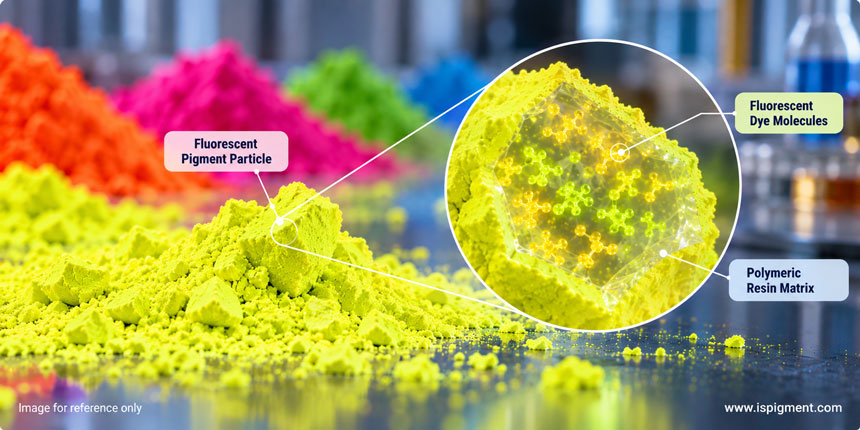
A daylight fluorescent pigment is different from a conventional insoluble color pigment.
Many organic fluorescent colorants are dyes. To turn these highly fluorescent molecules into a practical pigment, the fluorescent dye is incorporated into a solid resin matrix. Research into commercial daylight fluorescent pigments describes them as fluorescent colorants associated with an organic resin carrier, often together with other additives.[1]
Historically, amino resins have been particularly important carrier systems. Analytical studies have identified resin chemistries involving formaldehyde and amine-functional compounds such as melamine, urea and benzoguanamine. Depending on the formulation, these can include melamine-formaldehyde, melamine-urea-formaldehyde, benzoguanamine-formaldehyde and related copolymer systems.[1]
Other studies of daylight fluorescent pigments have similarly identified toluenesulfonamide-melamine-formaldehyde resin matrices.[2]
This distinction between a fluorescent dye and a fluorescent pigment is important. The resin is not simply an unnecessary filler around the colorant. It helps transform the fluorescent dye into a solid particulate material with properties suitable for processing in inks, coatings, plastics and other applications.
The historical use of formaldehyde-related amino resins is connected to the demanding optical and physical requirements of daylight fluorescent pigments.
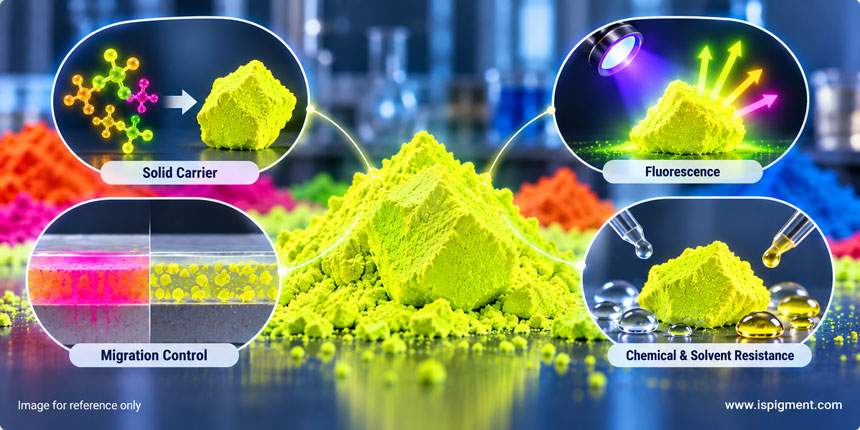
Fluorescent dyes need an appropriate environment to produce a useful daylight fluorescent pigment. Incorporating the dye into a polymer matrix converts the colorant into solid resinous particles that can be ground and dispersed as a pigment.
The matrix also needs to accept the fluorescent dyes while remaining sufficiently clear for efficient color development. Commercial technical literature for traditional fluorescent pigments has therefore emphasized characteristics such as a colorless matrix, good dye acceptance and suitable grinding properties.
More dye does not automatically produce more fluorescence.
At excessive concentration, interactions between fluorescent molecules can reduce luminescence through concentration quenching. Research on daylight fluorescent materials notes that the resin can dilute fluorescent dyes and help reduce this effect.[3]
The resin matrix therefore has an optical function as well as a mechanical one: it creates an environment in which a relatively small quantity of fluorescent colorant can generate a strong visual effect.
A free dye that dissolves too easily into the surrounding formulation can migrate, bleed or stain adjacent materials. Converting the fluorescent colorant into a resin-based pigment helps control this behavior.
For water-based inks and coatings, this property is particularly important because pigment stability is not determined by brightness alone. Resistance to the formulation medium, dispersion stability and migration behavior all affect whether the pigment remains usable during storage and application.
Crosslinked thermosetting matrices can offer resistance to solvents and other formulation components. A Chinese patent concerning formaldehyde-free fluorescent pigments notes that conventional melamine-type pigments have historically been used in water-based inks and textile color pastes partly because of their fluorescence, high degree of crosslinking and resistance to solvents that may be present in such systems.
These advantages help explain why amino-resin fluorescent pigments remained commercially important even after concerns about formaldehyde created demand for alternative technologies.
This question requires more precision than simply saying that a fluorescent pigment “contains formaldehyde.”
At least three concepts should be separated.
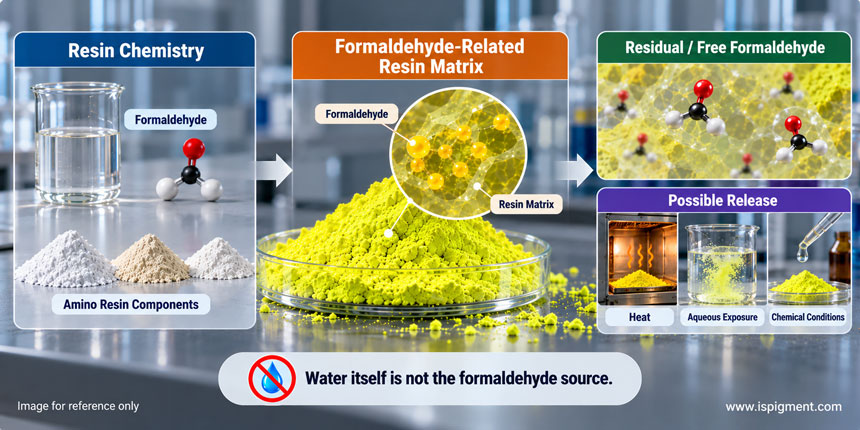
In traditional amino-resin technology, formaldehyde participates in the chemical reactions used to form the polymeric carrier.
Analytical research confirms that formaldehyde-based amino resins have been widely used as matrices for daylight fluorescent pigments.[1,2]
In this sense, formaldehyde is associated with the chemistry used to manufacture the resin.
Not all formaldehyde introduced during resin manufacture necessarily means an equivalent amount remains as free formaldehyde in the finished pigment.
Residual free formaldehyde may be associated with incomplete reaction or other manufacturing conditions. CN109135409B, for example, specifically attributes the free formaldehyde problem of the conventional melamine-type fluorescent pigment discussed in its background section mainly to formaldehyde remaining after insufficient reaction during pigment synthesis.
This is a much more precise explanation than saying that a water-based formulation itself creates formaldehyde.
A third issue is whether a formaldehyde-related polymer system can release formaldehyde under particular chemical or processing conditions.
Research on amino-crosslinked coating systems has shown that hydrolysis and formaldehyde release can depend on factors including crosslinker chemistry, curing conditions, aqueous exposure and temperature.[4]
However, this evidence should not be overgeneralized. It does not prove that every conventional fluorescent pigment continuously decomposes and releases formaldehyde whenever it is dispersed in water.
For practical evaluation, therefore, the question should be based on the actual pigment formulation and an appropriate analytical test rather than an assumption based only on the word “water-based.”
Water-based inks and coatings do not automatically require a formaldehyde-containing fluorescent pigment, nor does water itself generate formaldehyde.
The connection is more practical.
A fluorescent pigment intended for a waterborne system must maintain adequate dispersion and storage stability in an aqueous formulation while resisting undesirable swelling, agglomeration, migration and bleeding. This historically made highly crosslinked resin carriers attractive for certain applications.
At the same time, the liquid nature of water-based formulations means formulators may be concerned not only with the original raw material but also with what can be measured in the finished liquid system during storage.
This makes several questions relevant:
These questions are more useful than assuming that all pigments described as suitable for water-based systems have the same chemistry.
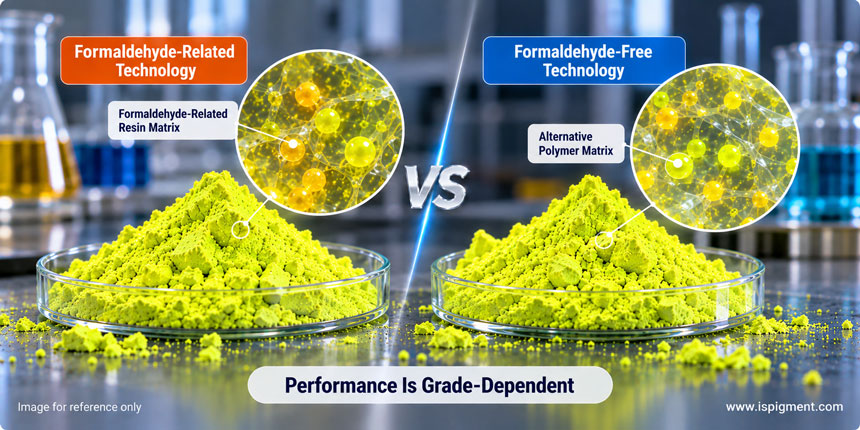
Modern fluorescent pigment technology provides alternatives to conventional formaldehyde-related amino-resin systems. However, selecting between them should involve more than checking a single “formaldehyde-free” box.
|
Factor |
Conventional Formaldehyde-Related Fluorescent Pigment |
Formaldehyde-Free Fluorescent Pigment |
|
Resin chemistry |
May use melamine-, benzoguanamine- or related formaldehyde-derived amino resin |
Uses alternative chemistry designed without formaldehyde as a resin building block |
|
Free formaldehyde |
May be detectable depending on chemistry and manufacturing process |
Should meet the supplier's defined formaldehyde-free specification/test criterion |
|
Fluorescence |
Conventional systems can provide strong daylight fluorescence |
Performance depends strongly on resin, dye and formulation design |
|
Water-based use |
Certain grades are specifically designed for aqueous systems |
Dedicated waterborne grades are available |
|
Dispersion stability |
Grade-dependent |
Grade-dependent; aqueous dispersion remains an important formulation challenge |
|
Migration/bleeding |
Depends on dye fixation and resin resistance |
Must be evaluated for the specific alternative matrix |
|
Solvent resistance |
Crosslinked conventional grades can provide good resistance |
Depends on the alternative resin technology |
|
Heat resistance |
Grade-dependent |
Some alternative matrices are designed for improved heat resistance |
|
Selection priority |
Performance plus formaldehyde specification |
Formaldehyde specification plus optical and application performance |
The most important lesson from this comparison is that formaldehyde-free describes chemistry or a tested chemical characteristic; it does not by itself guarantee superior performance in every application.
Recent research on formaldehyde-free aqueous fluorescent pigment formulations illustrates this point clearly. Researchers working with waterborne acrylic resin systems reported challenges involving pigment aggregation, dispersion stability and fluorescence efficiency and investigated molecular synergists to improve these properties.[5]
The optimized formulations achieved substantial improvements in dispersion and fluorescence, demonstrating that formaldehyde-free technology is developing rapidly. At the same time, the research shows why resin selection and pigment engineering remain important.
Formaldehyde-free fluorescent pigments are not based on one universal replacement resin.
Academic and industrial literature reports several alternative approaches. Polyester, polyamide and polyurethane-based matrices have been used for particular fluorescent pigment requirements, including applications requiring different heat or solvent resistance.[3]
More recent research has also investigated waterborne acrylic resins for formaldehyde-free aqueous fluorescent pigment formulations.[5]
Commercial technologies may use proprietary hybrid carriers or other modified polymer matrices. Because their detailed composition is often proprietary, two products both described as “formaldehyde-free fluorescent pigment” should not automatically be assumed to have identical properties.
The practical question for a formulator is therefore not simply:
“Is this pigment formaldehyde-free?”
It is:
“Does this formaldehyde-free pigment provide the required fluorescence, dispersion stability, resistance and compatibility in my actual formulation?”
This wording deserves careful treatment.
“Formaldehyde-free” can describe a technology formulated without formaldehyde as a raw material or resin-building component. In analytical testing, however, statements such as “not detected” depend on the test method and its detection limit.
For example, CN109135409B describes a formaldehyde-free fluorescent pigment and reports free formaldehyde below a detection limit of 5 mg/kg using the stated water-extraction and HPLC procedure.
That result is useful as an example of how a formaldehyde-free claim can be supported analytically, but it should not be interpreted as a universal specification for every formaldehyde-free fluorescent pigment.
Similarly, older commercial technical information from Radiant reported specific free-formaldehyde limits for certain product series and identified separate formaldehyde-free alternatives. Such values are product-specific and method-dependent rather than universal values for the entire fluorescent pigment industry.
For B2B purchasing, therefore, it is preferable to request a current specification, SDS and, where required, a relevant test report for the exact product grade.
For water-based applications, pigment selection should begin with the end-use requirement rather than with resin chemistry alone.
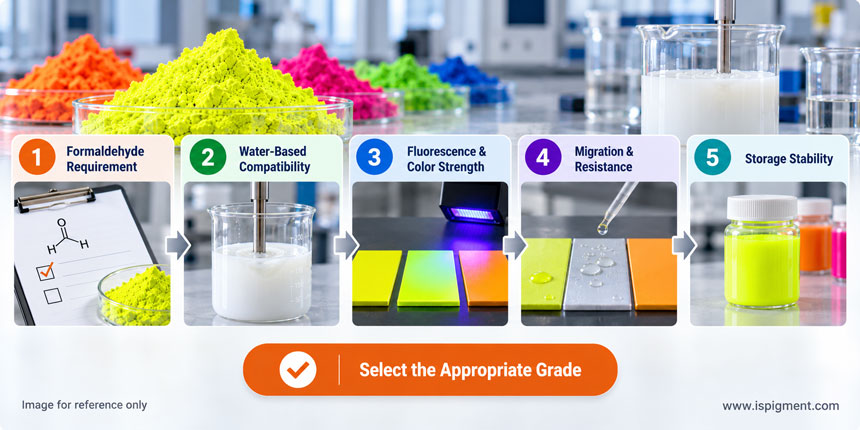
Determine whether the application requires a formaldehyde-free raw material or imposes a quantitative limit on free or releasable formaldehyde.
The distinction matters because “formaldehyde-free chemistry” and “measured formaldehyde below a specified limit” are related but not identical statements.
A pigment that performs well in one waterborne binder may behave differently in another.
Binder chemistry, pH, co-solvents, surfactants, dispersants, pigment loading and storage conditions can influence dispersion and stability. For water-based inks, particle size and rheological behavior can also affect printing performance.
Research on a fluorescent pigment used in water-based flexographic ink, for example, emphasizes the importance of even pigment dispersion and evaluates parameters including particle size, pH and viscosity.
The visual target should not be overlooked.
Changing the resin matrix can alter the microenvironment surrounding fluorescent dyes and therefore affect optical performance. Formaldehyde-free alternatives should consequently be compared at equivalent application conditions rather than judged from powder appearance alone.
For printing inks, textile printing, coatings and other applications where adjacent materials or liquids may contact the fluorescent color, migration and bleeding can be important.
The appropriate resistance test depends on the final system. Water resistance, solvent resistance, heat stability or chemical resistance may be more relevant for one application than another.
For liquid water-based systems, initial dispersion is only part of the problem.
The formulation should also be evaluated after appropriate storage for settling, agglomeration, viscosity change, color change and loss of fluorescence. Commercial suppliers sometimes refer to this broader requirement as in-can stability.
It would be inaccurate to classify every traditional fluorescent pigment as unsafe solely because formaldehyde chemistry may have been used in its resin matrix.
Safety and compliance depend on the actual composition, exposure route, measured concentration, intended application and applicable requirements.
It is equally inaccurate to assume that every modern fluorescent pigment is automatically safe or environmentally preferable simply because it is marketed as formaldehyde-free. Other formulation components and application-specific requirements still need to be considered.
For industrial buyers, a better approach is to evaluate the exact pigment grade through its technical data, SDS, relevant test results and intended application.
This is particularly important for applications with stricter chemical requirements, where a general product-family claim may not provide enough information.
The central issue is not that water-based systems inherently contain formaldehyde.
Traditional daylight fluorescent pigment technology often uses a polymeric matrix to convert fluorescent dyes into practical, insoluble pigment particles. Some historically important matrices are based on formaldehyde-related amino resin chemistry, including melamine-formaldehyde and related systems.[1,2]
Residual free formaldehyde can therefore be associated with the pigment manufacturing chemistry, while release behavior—where relevant—depends on the particular material and conditions rather than on the presence of water alone.[4]
Formaldehyde-free technologies provide alternative resin approaches and are increasingly relevant for water-based inks, coatings and textile systems. But resin chemistry also influences dispersion, migration resistance, fluorescence, heat resistance and other application properties.
For that reason, selecting a fluorescent pigment for a water-based formulation should balance chemical requirements with actual formulation performance.
A pigment should ultimately be evaluated not only by whether it is described as formaldehyde-containing or formaldehyde-free, but by whether it delivers the required fluorescence, color strength, dispersion stability and resistance in the intended application.
теги :
Авторские права © 2026 iSuoChem.все права защищены.
профессиональная команда для обслуживания !
 web@ispigment.com
 +86 13965049124
 русский
  English
 français
 italiano
 español
 português
 العربية
 한국의
한국의 ไทย
ไทย Tiếng Việt


